

CMF adjuvant chemotherapy for operable breast cancer: A change of paradigm
Authors:
Silvio Monfardini
,Alberto Costa
,Emiel Rutgers
Date of publication: 25 February 2026
Last update: 25 February 2026
Abstract
In 1966, Paul Carbone at the National Cancer Institute (NCI), Bethesda, pioneered the concept of « adjuvant chemotherapy » - using drugs after radical mastectomy to prevent recurrence. By 1972, Carbone shared promising results of the CMF regimen (cyclophosphamide, methotrexate, fluorouracil) with Italian oncologist Gianni Bonadonna, leading to their collaboration.
In February 1973, a NCI-funded study with adjuvant CMF in breast cancer patients with positive lymph nodes was launched at the Milan Istituto Nazionale Tumori, coordinated by surgeon Umberto Veronesi and medical oncologist Gianni Bonadonna. The trial was conducted in Italy rather than the USA due to factors including homogeneous surgical treatment, lower costs, and reduced ethical constraints about untreated control groups.
A 1976 publication in The New England Journal of Medicine showed that premenopausal patients with positive lymph nodes receiving CMF had significantly fewer recurrences than those receiving surgery alone. Long-term follow-up published in 1995 confirmed these benefits after nearly 20 years.
This trial revolutionized cancer treatment by demonstrating that breast cancer was often also systemic rather than purely local, requiring both surgical and medical intervention. It established the principle of treating patients with "no clinically apparent disease" after local treatment, fundamentally changing oncological practice and extending to other cancers the concept of combination chemotherapy.
The collaboration between surgical and medical oncologists represented a pivotal moment that transformed the treatment of breast cancer consisting only in the local surgical approach into a multidisciplinary treatment required by the possible systemic diffusion of the disease.
Introduction
In the early 70s the demonstration of the usefulness of the anticancer chemotherapy in malignant lymphomas and to a lesser extent in some advanced solid tumors, such as breast cancer, arose in the United States and Europe the question on the possibility of using antitumor drugs to decrease the risk of relapses after the initial radical surgery. The possibility of reducing the risk of recurrence and death of women with breast cancer after surgery was an appealing idea, but it was accompanied by the fear of exposing patients to the toxicity of chemotherapy in absence of the demonstration of its usefulness.
Paul Carbone, a thirty tree years old medical oncologist from the Medicine Branch of the National Cancer Institute (NCI), Bethesda, had launched in 1966 a trial to see if chemotherapy might help when administered after radical mastectomy, and called this strategy adjuvant, from the Latin to help but he had problems in recruiting patients, since surgeons where not interested in getting help from the chemotherapists (Mukherjee 2010).
The beginning of the story
In May 1972 Paul Carbone, at that time NCI Associate Director for Medical Oncology and chairman of ECOG, one of the largest American organizations for clinical trials in adult tumors, showed to Gianni Bonadonna, during one of his frequent trips to the USA, the Medicine Branch Annual Report he had written a few months earlier. Bonadonna was well known at the NCI since, before arriving at the Milan Cancer Institute, he had been working at the Memorial Hospital of New York for four years. Furthermore, with his group in Milan, he had achieved relevant results with the development of Adriamycin and of the ABVD combination for Hodgkin's disease. The detailed story of this contact was reported in 1989 by Bonadonna in his Karnofsky Memorial Lecture on «Conceptual and Practical Advances in the Management of Breast Cancer» (Bonadonna 1989).
The report shown by Carbone to Bonadonna before publication included the first data on a quadruple drug regimen, CMFP: cyclophosphamide, methotrexate, fluorouracil and prednisone. The results of a study conducted on women with advanced breast cancer had been showing complete remission in 20% of cases and partial remission in 40%. At that time they knew that positive results with CMF plus Prednisone in advanced breast cancer had been obtained by Georges Canellos in a few patients. This led them to think that CMF was superior to L-phenylalanine mustard (L-PAM). The results discussed by Carbone were later published in Cancer (Canellos 1976).
Bonadonna was also informed on a protocol proposed by the Eastern Cooperative Oncology Group (ECOG): they were comparing another therapy for advanced breast cancer, called CMF (cyclophosphamide, methotrexate and fluorouracil, developed by the NCI) with L-PAM. In the same period, at the Milan Cancer Institute, CMF had already been tested by Cristina Brambilla and coworkers in patients with advanced breast cancer. The regimen had been proven to be feasible and tolerable in the Italian cases, with data published only later (Brambilla1976).
Belladona subsequently read the draft of a study by the National Surgical Adjuvant Breast Project (NSABP) directed by Bernard Fisher and study aimed at verification of the effectiveness of mastectomy followed by L-PAM adjuvant chemotherapy, compared to mastectomy alone in breast carcinomas with positive axillary lymph nodes. Carbone and Bonadonna were then in agreement that it was worthwhile testing a combination of drugs such CMF, which had provided remarkable results in advanced breast cancer when compared to the single agent L-PAM used by Fisher.
It was then necessary to test the option of mastectomy followed by the new CMF adjuvant therapy and compare the results with mastectomy alone. Since it was difficult in the U.S. to get surgeons and oncologists to work together, Paul Carbone agreed on verifying the effectiveness of the combination at the Istituto Nazionale Tumori of Milan, where the surgeon Umberto Veronesi had operated an extensive number of women with breast cancer. At that Institute there was surgeons' compliance with the established institutional techniques for breast surgery. Carbone was also aware of the good professional relationship of the surgeon Veronesi with the medical oncologist Gianni Bonadonna, whose team operated in an entire floor dedicated to medical oncology, with a big outpatient clinic of the same Institute (Minerva 2013). Vincent De Vita affirmed that no single U.S. institution would take on the follow-up of the “new” combination chemotherapy adjuvant trials, so Paul Carbone used his international links to develop a contract with the Istituto Nazionale Tumori of Milan for the testing of the early CMF breast cancer studies (De Vita 2002). Gianni Bonadonna drafted the protocol which was immediately approved by Paul Carbone (Bonadonna 1989).
A cancer Institute to carry out the study
This adjuvant trial was sponsored by the NCI and founded with the activation of several contracts to be run at the Istituto Nazionale Tumori in Milan. The NCI requested an approval of the Ethical Committee, but this was still not existent at that time, so that Bonadonna asked the Director of the Institute Pietro Bucalossi to set up such a Committee and the trial was then approved. The activation of the trial was preceded by an NCI site visit.
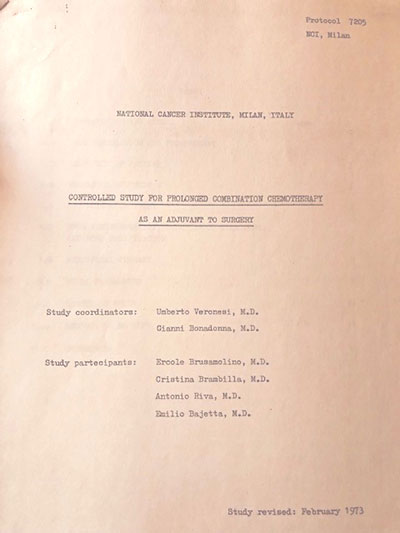
The figure 1 shows the first page of the original 13 pages protocol. The study coordinators were the Surgeon Umberto Veronesi and the Medical Oncologist Gianni Bonadonna.
| Figure 1 |
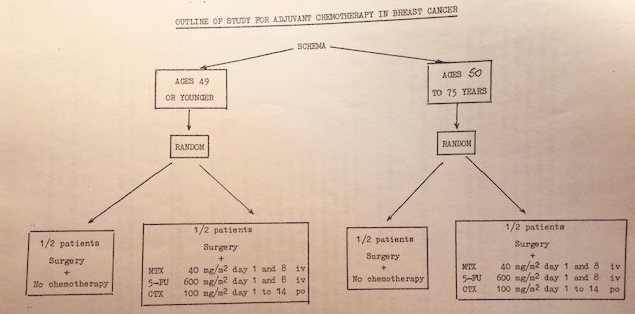
The figure 2 shows the outline of the study for operable breast cancer with metastatic axillary lymph nodes.
| Figure 2 |
Worth of note is the reduced treatment intensity planned in patients older than 60 years and the exclusion from the treatment of patients older than 75 years, based on the idea that older patients could not tolerate a full dose chemotherapy. This is historically important since these events precede the development of Geriatric Oncology, but that there was already the belief that age should be an important factor to be considered before treatment.
The writer of this article recalls that after the activation of this protocol most of the activity of the medical oncology outpatient clinic was dedicated to the patients entering in this study. All medical oncologists on staff saw these patients, in particular followed by Emilio Bajetta, Gabriele Tancini, Anna Rossi, Cristina Brambilla and Ercole Brusamolino, with an unprecedented flow of sheets reports from the clinic to the newly instituted Operation Office led by Pinuccia Valagussa.
Why a trial funded in the USA was carried out in Italy?
It may surprise that a trial designed and funded by an American Institute was carried out in a European nation and not in the USA. Various reasons determined this choice. Among them the availability of a public cancer Institute with a strong reinforcement of the clinical treatment policy, established by the Institute Director Pietro Bucalossi, implying the possibility of a widespread homogeneous treatment. All patients meeting the trial requirements could be enrolled in it, differently from the situation of the surgical private practice in the USA allowing surgeons, often hostile because the fear of toxicity (Keating 2012) to make their own choice of the possible postoperative treatment. The availability of a large cases series surgically treated and studied at the Institute (Minerva 2013) was also an important factor, together with the substantially decreased cost of the trial in comparison with the USA, since the study was to be conducted in a public institution where all expenses related to laboratory and radiologic examinations were covered by the public reimbursement system. A further explanation has been provided by Keating and Cambrosio: in the USA, once even preliminary data had shown that L-PAM was superior to placebo, it could be unethical not to administer chemotherapy, but a trial randomly assigning to receive either no further treatment after radical mastectomy or adjuvant chemotherapy was badly needed (Keating 2012). It could also be speculated that on the Italian side there was a higher confidence with the CMF regimen that could be administered at that time on an outpatient basis in the Medical Oncology Clinic of the Institute with the better familiar and logistic support for breast cancer patients to be referred, in their majority from the Milan area.
«In just two years the institute had been able to enroll 386 geographically accessible patients with operable breast cancer and positive lymph nodes» (Bonadonna 1989). Therefore, available large case series, homogeneous treatment policy and the marked decreased costs of the trial, due to the public coverage of the treatment and diagnostic examinations, oriented the America choice toward Italy.
At the beginning there was some skepticism on the side of the surgeons of the Institute concerned with the toxic effects of chemotherapy, similarly to their American colleagues. They were initially not entering all their patients in the trial, certainly to less extent their private patients. But gradually an acceptance of this revolutionary trial-treating patients in absence of disease with a toxic chemotherapy took place. The controversy on adjuvant therapy represented a challenge to the prevailing paradigm that cancer was a local disease requiring a local treatment such surgery alone. The idea that successful surgery might need additional medical therapy was threatening to surgical sensibilities, because it implied that surgery alone might not be sufficient treatment for cancer. This passage was a pivotal moment in breast cancer treatment history.
Changes in the running of the clinical studies at the Istituto Nazionale Tumori of Milan
The logistic of the clinical trial required a change in the way of running clinical studies for the Medical Oncology team at the the Istituto Nazionale Tumori of Milan. In Bonadonna's group since the late 60s, in order to avoid spontaneous deviations that would have invalidated the results, before starting a clinical trial of a new drug a specific document containing all the rules to be followed was always prepared. The first protocols appeared in a very reduced form, mostly just a single page, for the testing of Adriamycin. This was already a controlled experiment in which patient characteristics, treatment type, dosage, predictable toxicity, and dose reductions based on blood count were established in advance. However, at this stage the statistical component was very marginal. The goal was to describe results of previously unknown drugs. The problem of finding differences between one type of treatment and another had already been addressed in the Institute by Veronesi in planning the study comparing mastectomy to quadrantectomy, with the type of treatment chosen randomly. It was therefore a controlled, randomized trial.
The use of this type of study in medical oncology arose became necessary to determine if the treatment with CMF chemotherapy after surgery could improve prognosis. The change in the usual working methods and the transition to controlled and randomized studies received a decisive push by the research contracts signed with the NCI.
New cases were reported to the Operations Office, which screened the inclusion data and provided periodic data collection and processing with the physician responsible for the study. The era of the doctor who did everything alone was coming to an end: seeing patients, treating them (obviously not all of them), and then collecting the files of cases they had noted and, in extra work hours, trying to extract data at the end of the study to try to establish what had happened, after some time had passed (Bonadonna 1978). A large underground space was then occupied by a biostatistics office headed by the statistician Pinuccia Valagussa, with a workstation for data managers: it was the first example of an always functioning collaboration between biostatistics and clinical work. This was very different from previous sporadic contacts with high-level biostatisticians, who often struggled considerably to understand the clinical problems and data collection methods.
The writer recalls: «Pinuccia, small in stature, entirely dedicated to work, humanly available. She would fix us with her round eyes from behind her glasses, often with a cigarette between her fingers when asked a question. The answer was never trivial. A faithful companion in Bonadonna's professional adventure, she would share his notoriety and difficult moments.»
The positive results and the change of paradigm
When the first positive results were about to be published some doubt was instilled from an English surgeon to Umberto Veronesi, but this was overcome with the support of the data provided biostatistician Pinuccia Valagussa (Valagussa personal communication). The article on the initial results was published in The New England Journal of Medicine in 1976 (Bonadonna 1976). Premenopausal patients with positive axillary lymph nodes and therefore at higher risk of local or distant recurrence, when treated with CMF were less likely to develop recurrences in subsequent years compared to those who underwent surgery alone.
The long-term results of this trial of adjuvant combination chemotherapy confirmed after 20 years of follow up the preliminary observations of the effectiveness of the treatment in premenopausal women with node-positive breast cancer (Bonadonna 1995). After a median follow-up of 19.4 years, the premenopausal given patient adjuvant combination chemotherapy had significantly better rates of relapse-free survival and total survival. As Bonadonna himself recalls in his Karnofsky Memorial Lecture on «Conceptual and Practical Advances in the Management of Breast Cancer» (Bonadonna 1989) the publication in 1976 of the first study produced an unexpected and explosive reaction among physicians: the fact that adjuvant chemotherapy was working for a solid tumor suggested that a disease previously considered local, curable only surgically, could actually be systemic. The appearance of distant metastases prompted testing of adjuvant therapies, and now the extraordinary results suggested the possibility that chemotherapy could work in other solid tumors as well. That it wasn't just a palliative treatment for advanced tumors. From a conceptual standpoint, this represents a very strong break with the past: it's the grand entrance of multi-drug chemotherapy following surgery for preventive purposes. Bonadonna in his Karnofski lecture affirmed: «Our study, together with that of Fisher's NSABP group (Fisher 1975), revealed not only the predominantly systemic nature of certain breast cancer subtypes, but also the value of multi-drug treatment combined with surgery» (Bonadonna 1989).
It was the beginning of a new era. This passage captures a revolutionary moment in cancer treatment - the shift from viewing cancer as a purely local disease to understanding its systemic nature.
Conclusions
This trial determined a real change of paradigm since after its publication Medical Oncologists began to treat not only patients with advanced tumors, but also patients with no clinically apparent disease after local treatment (surgery or radiotherapy). In first and second stage lymphomas, for example chemotherapy would also begin to be administered after radiotherapy (Monfardini).
With this trial of adjuvant CMF in breast cancer Carbone and Bonadonna were witnessing the emergence of combination chemotherapy protocols that would revolutionize breast cancer treatment. It is not to be missed the essential role the surgeon Umberto Veronesi for the take off and running of the trial that produced the first strong evidence of the effectiveness of the method.
References
Bonadonna G. 1989. Karnofsky memorial lecture. Conceptual and practical advances in the management of breast cancer, J. Clin. Oncol. 7(10), 1380-1397.
Bonadonna G., Brusamolino E., Valagussa P., et al. 1976. Combination chemotherapy as an adjuvant treatment in operable breast cancer. New England J. of Med., 294, 405-410.
Bonadonna G. Valagussa P., Moliterni A., et al. 1995 Adjuvant Cyclophosphamide, Methotrexate, and Fluorouracil in Node-Positive Breast Cancer - The Results of 20 Years of Follow-up. N Engl J Med, 332, 901-906.
Bonadonna G. and Valagussa P. 1978. The logistic of clinical trials, Biomedicine, 28, 43-48.
Brambilla C., De Lena M., Rossi A., et al. 1976. Response and survival in advanced breast cancer after two non-cross-resistant combinations. Br Med J, 1,801-804.
Canellos G.P., Pocock S.J., Taylor S.G. III, et al.1976: Combination chemotherapy for metastatic breast cancer: Prospective comparison of multiple drug therapy with L-phenylalanine mustard. Cancer. 38, 1882-1886.
De Vita V., Carbone P., 2002. in Memoriam. _The Oncologist. _7, 92-93.
Fisher B., Carbone P., Economou S.G. et al. 1975. L-phenylalanine mustard (L-PAM) in the management of primary breast cancer, in New England J. of Med.,292, 110.
Keating P., Cambrosio A., 2012. Cancer on Trial. Oncology as new style of Practice. The University of Chicago Press, London, p 207.
Keating and Cambrosio. 2012. Cancer on Trial. Oncology as new style of Practice. The University of Chicago Press Ltd, London p 208.
Minerva D. and Monfardini S.: Il bagnino ed i Samurai 2013.La ricerca biomedica sprecata. Codice Edizioni, Torino.
Monfardini S., Banfi A., Bonadonna G .1980. Improved five year survival after combined radiotherapy-chemotherapy for stage I-II non-hodgkin's lymphoma. Int. Journal of Radiation OncolBiolPhys., February, 125-134.
Mukherjee S., 2010. The Emperor of All Maladies. A Biography of Cancer. p. 219. New York: Scribner.
Veronesi U., Saccozzi R., Del Vecchio M. et al. 1981. Comparing Radical Mastectomy with Quadrantectomy, Axillary Dissection, and Radiotherapy in Patients with Small Cancers of the Breast. N Engl J Med;305.6-11.
1966
Paul Carbone a thirty tree years old medical oncologist from the Medicine Branch of the National Cancer Institute (NCI), Bethesda, launched a trial of chemotherapy after radical mastectomy, and called this strategy adjuvant.
May 1972
Paul Carbone, at that time NCI Associate Director for Medical Oncology at NCI and chairman of ECOG, showed to Gianni Bonadonna the positive results of a quadruple drug regimen, CMF P in advanced breast cancer. Bonadonna was also informed on the National Surgical Adjuvant Breast Project (NSABP) designed to verify the effectiveness of mastectomy followed by L-PAM adjuvant chemotherapy compared to mastectomy alone.
February 1973
Activation at the Istituto Nazionale Tumori of Milan of the study of adjuvant CMF study after radical mastectomy in breast cancer patients with positive axillary lymph nodes, supported by the NCI and coordinated by Umberto Veronesi and Gianni Bonadonna.
February 1976
Publication in The New England Journal of Medicine of data showing that patients with positive axillary lymph nodes treated with CMF were less likely to develop recurrences in subsequent years compared to those who underwent surgery alone.
April 1995
Publication in The New England Journal of Medicine of the long-term results of the trial of adjuvant combination chemotherapy, confirming the preliminary observations of the effectiveness of the treatment in women with node-positive breast cancer.


